
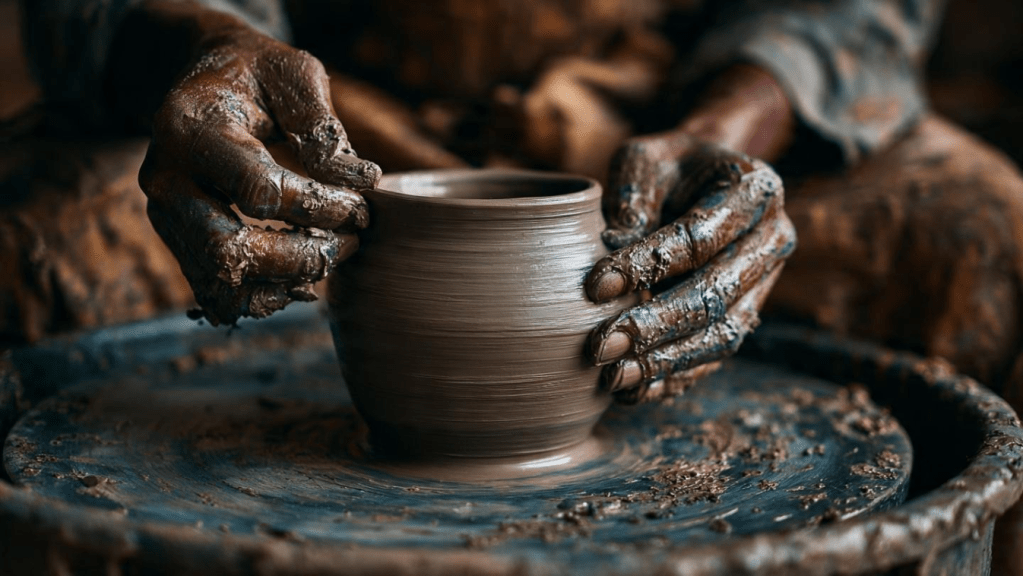
Earthen Vessels: The Paradox and the Promise of Christian Witness
By Rev. Anand Veeraraj
“For what we preach is not ourselves, but Jesus Christ as Lord, and ourselves as your servants for Jesus’ sake. For God, who said, ‘Let light shine out of darkness,’ made his light shine in our hearts to give us the light of the knowledge of God’s glory displayed in the face of Christ. But we have this treasure in jars of clay to show that this all-surpassing power is from God and not from us.” [2 Corinthians 4:5–7 NIV].
Let us begin with an absurd picture. Imagine you own a diamond worth millions. Where do you keep it? A bank vault? A biometric safe? A triple-locked closet? You would not walk to the kitchen, grab the chipped clay pot you keep curd in, and bury the diamond in rice. Paul’s image is exactly that. And he means it. God places the most precious thing in the universe — Christ, the Logos, the Living Word — in you and in me. Breakable, moody, forgetful, boastful, sin-prone you and me. Why? So, no one is confused about where the power and honor come from. It is God’s. Not ours.
I learned this in a village storeroom. Every summer as a teenager, I stayed in a farming village in Tamil Nadu with my sister. Her mother-in-law was there too. Picture her: small frame, back bent a little with age, eyes dim with years. She could not see well, but she ran her land like a CEO. She owned some jewelry. Her heirloom. Being a widow, she never wore it. She kept it in a small cloth bundle. Here is the kicker: she hid that bundle inside a kuthil, a clay grain bin. Hers were huge, five feet tall, standing like silent sentinels in the storeroom. She had six of them. Every few days, when no one was around, she would slip into that dark room and move the bundle around. Today it is hidden in ragi. Tomorrow, rice. Only she knew where the pouch was hidden on any given day. When she died, her loved ones turned that storeroom upside down. It took days. They finally found it under the kambu [millet]. Today we trust HDFC and ICICI. But God still likes clay pots.
Apostle Paul wrote this epistle to a messy church: Corinth. Paul started it. Then he left to start churches in other cities. Everything exploded. They had every problem imaginable. People sleeping around, suing each other, showing off spiritual gifts to look holy, getting drunk at communion. It was chaos. Had I received that pastoral call to serve the church in Corinth, I would have, like Jonah, taken the next boat to Tarshish! So, Paul looks them in the eye and says: Listen. You are not gold. You are clay. Sun-baked, cracked, ordinary clay. The only thing that makes you special is what I put in you. What changes when you actually believe this? You will walk with a limp, and that is good.
1. We love to act strong. My jāti, my degree, my bank balance, my family name. We take pride in them. But one fever, one job loss, one betrayal, one Fentanyl overdose, and we shatter. We break into a million different pieces at the drop of a hat. Apostle Paul had a “thorn in the flesh.” We do not know what it was. A disease? Anxiety? A persistent temptation? He begged God three times: Take it away. God said “No,” and went on to add, “My grace is sufficient for you, for my power is made perfect in weakness. So, Paul flipped it. What the heck! Went on to retort, “Therefore I will boast all the more gladly about my weaknesses, so that Christ’s power may rest on me.”. (II Corinthians 12:9 NIV).
2. Cowards become audacious! You know Peter, the rock. Swore he would die for Jesus, then fell apart when a maid in the hallway confronted him saying, “Weren’t you with him?” He denied Jesus three times before the rooster crowed. Just a few weeks later: same Peter, different man. He walks into the temple, sees a man crippled from birth, and says, “In the name of Jesus Christ of Nazareth, get up and walk.” The man jumps to his feet, singing and praising God. The religious leaders dragged Peter in. They are stunned. He is a fisherman. No seminary. No pedigree. But he is on fire. What happened? Peter stopped trusting the brittle stone. He started trusting the Treasure.
3. God picks what the world ignores. We love gold cups. God loves clay cups. He picked fishermen over philosophers. He still does. Look at India. We are 1.4766 billion and counting. The Brahmin priestly class is maybe 5%. For centuries, these pundits kept the Vedas from everyone else. But 60% of us are Dalits, Adivasis, tribals, Shudras. We were told for generations, “You are not qualified; you don’t deserve; you are polluted.” Guess who God picks to carry His precious Word? The Logos! Mud pots like us – folks with dirt on their feet and calluses on their hands. Paul said it straight: “For the message of the cross is foolishness to those who are perishing, but to us, who are being saved it is the power of God” (I Corinthians 1:18 NIV).
4. One treasure, many vessels — because God doesn’t do solo acts.
Think about it. One diamond. But God refuses to lock it in one safe. He scatters it. Widow’s kuthil. Fisherman’s hands. Dalit grandmother’s cracked pot. Your pot. My pot. God did not trust the gospel to a gold-plated celebrity. He handed it to a ragtag crew who were fragile, bereft and forlorn. That’s the point. If one breaks, the Treasure still blazes. If one hides, another steps into holding the light.
The early church was by no means homogeneous. It was a holy rampage of humanity — Greeks, Romans, Jews, male, female, wealthy, centurion, poor, masters, slaves, married, singles, adults, seniors, widows by the dozen, children, circumcised, uncircumcised, gays, lesbians, and others. You name them, they were there. God the Potter looks at that pile of mud pots and says, “These? I can mold and make. I’ll invest the priceless Treasure in these.” I’ve witnessed it firsthand. Dalit pastors in Tamil Nadu and elsewhere hold that Treasure with more dignity and grace than many gold-plated cathedral priests.
Sometimes, we carry it alone — in hospital rooms, in secret prayers, in 2 AM grief counselling, with a bereaved family. We carry it together — in messy churches, in EcoCovenant Nexuses, in village churches where caste still draws blood. One Treasure. Many jars. All of them cracked. All of them ooze grace. Providentially, they all end up as saints on stained glass panels. So Great a Cloud of Witnesses! (Hebrews 12:1).
5. The church is a messy place. Corinth was not unique. Every church is one squabble away from fracturing, splitting. We are all breakable. That is why Paul says, “Bear one another’s burdens.” So, we carry each other. The gospel does not just forgive you. It gives you a new family name. You did not earn the honor. You received it because Christ lives in you. So, we wash feet, clothe the naked, feed the hungry. We forgive seventy times seven and receive forgiveness in return. We bring our unique cultural cuisine dishes to the table to share with friends and strangers. We stay at the table and fellowship together even when it is awkward.
Here is the part we do not like to talk about. Clay pots break. In my village, when a pot cracked, we did not do kintsugi. We did not mend it with gold. We tossed it behind the house with the other shards. That is us. Dust. Carl Sagan, the astrophysicist, famously said we are made of stardust. The Bible said it first: “You are dust, and to dust you will return.”
I feel uneasy reciting those words every time I conduct a funeral. We sing, “It is well with my soul.” People tell stunning stories about the departed soul. Then we walk to the burial ground, carrying the body. When the casket is lowered into the pit, I scoop a handful of dirt and sprinkle it on the casket, and recite, “Dust to dust, ashes to ashes.” It always catches in my throat. Minutes ago, we were celebrating life. Now we are saying, “dust and ashes.” Indeed, life on earth is irony wearing flesh.
But here is the hope. We are not just dust. We are dust with Treasure. Christ in you. No angel, no animal, no star has that honor. The pot breaks. The Treasure does not. If you hold on to Christ, you do not really die. You go home. So, I ask you now. Jesus said, “Where your treasure is, there your heart will be also.” What are you clenching in your little clay heart? Your reputation? Your jāti? Your race? Your grudge? Your phone? Or the One who was broken so you could be whole? God made a crazy bet. He put heaven’s gold in earthen jars. In you. In me. Let us live like we know it. Humble. Bold. Carrying each other. Pointing to Christ.
May God be with you. Amen.
© 2026 Anand Veeraraj. All rights reserved. [Updated with AI editorial assistance].
www.PrincetonForum.org | veerarajanand@gmail.com
Note: This article was originally published in the book by Anand Veeraraj, Earthen Vessels: The Paradox of Christian Leadership [Bangalore, India: Centre for Contemporary Christianity, 2010], pp. 1–6. Copies available in Seminary Libraries and sold at ELS Book Stores in India.
 PRINCETONFORUM.ORG
Leave a comment