
On June 7, 2007, two significant events took place in our family’s life. At 5:00 a.m., my daughter Amitha called from the maternity ward in Cannon, New Hampshire. She had just given birth to our grandson, Derek. He is our fifth grandchild and Amitha and Jack’s third child, their first son. It was a moment of great joy.
Later that same day, at Princeton Theological Seminary, a consultation on Asian Indian Ministries in North America was held. More than sixty Asian Indian clergy, women, and youth leaders gathered from New York, New Jersey, and Pennsylvania. Some represented congregations engaged in outreach to the Asian Indian diaspora. The theme of the consultation was “Multiplying Asian Indian Ministries in North America.”
At the close of that meeting, the proposal to establish the Princeton Forum was formally adopted. The Princeton Forum [PF] was created to address the concerns and hopes of South Asian Christian diaspora communities in North America. In a deeper sense, it was born the same morning Derek was born. That connection matters to us.
Princeton Forum has existed and operated quietly for nearly twenty years. We have not sought public attention. Our work has focused on projects, programs, and relationships that reflect our mission. You can find our history and vision on our website.
What is the meaning behind the name? What philosophy, theology, spirituality, and ethics guide our work? Princeton + Forum. We chose this name on June 7, 2007, after extensive discussion, prayer, and planning. We are grateful to the donors who provided initial support for our mission.
The word “Princeton” carries considerable weight because of Princeton University. We recognize that association. To be clear: the Princeton Forum has no formal connection to the University. We receive no funding or endorsement from it. However, by divine providence, a small Asian Indian Christian congregation found a home in the heart of Princeton Township. The community welcomed us. We worshiped at Christ Congregation on Walnut Street, across from Westminster Choir College. We entered into fellowship
with other churches in Princeton and with the Church of South India Council in North America across the Tri-State region.
Being located in Princeton gave us a particular perspective. We began to ask: What is the global responsibility of a local church? How do we bear witness in an interconnected, digital age without reducing the gospel to a marketing strategy? Our answer was to create a platform that is not centered on itself. We seek to broaden our horizons. The gospel addresses not only local needs but God’s concern for all humanity and for the whole creation. We understand ourselves as beings made in the image of God, living as part of the natural world, alongside its plants and animals. We belong to it.
The word “Forum” indicates an open table. It is an invitation to conversation. It suggests a round table, and ecumenical spirit. Anyone interested in peace, justice, beauty, ecology, and God is welcome. Bring your insights. Bring your experiences. This is a shared space.
This brings us to “Lake at Dawn,” the painting reproduced on the cover by Amitha Christine Coulter. In the painting, dawn breaks through a grove of trees. The lake reflects the light, creating the impression of a second sky. Reeds grow in the foreground. Two geese rise into the open canopy. The scene presents only light, roots, and water that endures. We might call this the Savannah Gestalt — a deep human recognition of landscape that sustains life. It stands in sharp contrast to the values of a purely economic worldview. Ecological science confirms what we sense intuitively: trees flourish near
water. Roots grow deep into the soil and communicate with streams.
This is not only botany. It is also anthropology. For 200,000 years, human beings evolved at the boundary between forest and grassland. Water meant survival. Trees meant shelter, food, orientation, and safety. That memory remains in us. When we see light refracted through sycamores and a lake that seems sacred, we respond with a sense of recognition.
We call that response beauty. Modern thinkers have described a condition of “Cosmic Homelessness.” Post-moder visionaries speak of homesickness — the longing for Walden, for open prairie, for a stream beyond the sound of traffic. It is a desire to be embraced by the natural world, which we might think of as our ancestral home. Thoreau went to the pond for the same reason Augustine encountered God in a garden. The image is consistent: roots growing deep, branches extending wide, bearing fruit for neighbors
and strangers alike. Heaven is not an abstract cloud. It is an unending sabbath gathering in a flourishing park — God and humanity walking together in the cool of the day. Our life now is a prelude for that everlasting ecology. We are calling this vision, Lake at Dawn.
It represents a new philosophy, a new spirituality, a new hope, and a new way of living. We see it as Paradigm 2.0. Here are ten foundational points. We will develop them further in future series:
- Process is Reality. Nothing is static. Everything is in motion. We are not fixed
objects but unfolding events. - The past shapes the present. Who we are now reflects the full inheritance of our
past. We cannot modify what has been, but we can receive it with gratitude. This
is true for every part of nature. - The present is what we have. This moment, this breath, this light. It is given to be
lived fully. - The present shapes the future. The future is open and offers many possibilities.
The choices we make matter. We need wisdom to choose well, and we look to the
Logos for the discernment we need. - We are not surrounded by tools, but by neighbors. Every entity — however small
— has intrinsic worth. Modern systems prize instrumental value: What can this do
for me? Our schools teach it. Our markets depend on it. But if everything is
reduced to its use, we erode the foundation of life itself. - No one exists in isolation. Each person is connected to others — human and
nonhuman — in a complex network of relationships. We live in communities
within communities. - We do not control one another’s destiny. As adults, we are responsible for our
own lives. We do not dictate the path of our neighbors. - We are not machines. We possess free will and agency. With that power comes the
responsibility not to misuse it. - We exist for mutual flourishing. Our purpose includes contributing to the
wellbeing of others, and we may expect the same in return. - All things are held by grace. Each of us, together with the natural world, is
embraced by divine love.
A recent experience illustrates this philosophy. Last weekend, Amitha, Jack, and their
three children visited Elk River Falls in Elk Park, North Carolina. When they lived in
Canaan, New Hampshire — some years ago — the Coulter family made their home in
wooded areas near streams, lakes, and gorges. They are committed to outdoor life:
hunting, fishing, skiing, hiking, mountaineering, rock-climbing, kayaking, and bicycling.
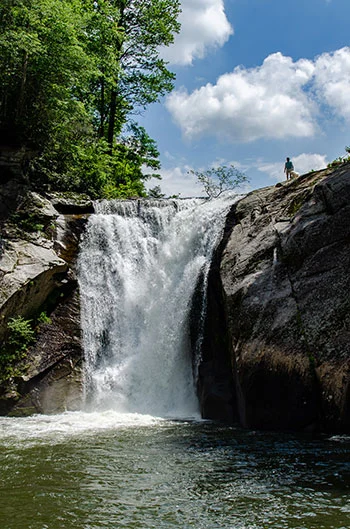
A few years ago, the family moved to North Carolina. Last weekend the family were on vacation in Blue Ridge Mountains. On Sunday, June 21, 2026, while the rest of the family was still asleep, Jack went alone to Elk River Falls at approximately 8:00 a.m. He took the photograph shown below. Jack wrote: “It was a peaceful area. There was nobody around and I was able to spend some time praying and thanking God for his wonderful creation.” That statement truly reflects the foundational spirit of the Princeton Forum. Encounters with creation draw us closer to the Creator. Standing beside moving water in the early morning hour, we remember that we are loved and that we belong to this world. It is both vast and personal.
Welcome to the world of God’s creation.
Thank you, Amitha and Jack Coulter.